Thursday, May 12, 2011
Best blog post, second semester

Tuesday, April 19, 2011
A Day in the Life of a Red Guard
Long Live our Great Chairman!
紅衛兵戰士很生氣
今天,我推翻了老師,因為他的資產階級的方式將不再滲透,感染我們的心靈。名譽會長萬歲!毛澤東萬歲!我現在是老師,我的同行,並教他們如何的名譽會長。名譽會長萬歲!毛澤東萬歲!我們燒掉所有的教科書,他們的所謂的知識和謊言將不再進行研究。我們現在研究一書:紅寶書。名譽會長萬歲!毛澤東萬歲!餘,鄧任彥,現在我的同事在領導我國的解放,毛澤東的國家!名譽會長萬歲!毛澤東萬歲!我的學生應成為士兵的毛,我已成為一名軍人。他們應感到勝利的勝利,或者是壓在腳跟主席。名譽會長萬歲!毛澤東萬歲!我們的部隊應沖刷農村,繪畫全國紅色的!沒有資產階級的規定繼續,官僚機構應崩潰,毛將再度崛起,成為一個領導人民新一代的繁榮。名譽會長萬歲!毛澤東萬歲!與毛澤東作為我們領導者,我們升到從黑暗深處骯髒!毛澤東萬歲!毛澤東萬歲!毛澤東萬歲!毛澤東萬歲!人民的中國,毛澤東的中國,應鉛的脖子伸進新一代,以武力如果必要的!
Bao (Alexa and Nicole)
Imagining Life During the Cultural Revolution
My name is Mei Ching, and I am a 21 year old woman living in an apartment in Mao's great city of Beijing. This morning I woke up to the smiling image of Mao's face. For my breakfast, I ate a modest of grains and fruit. While I ate, I listened to the radio. As the songs praising Mao filled my room, I felt joyous and blessed to be living in a country as great as China. My occupation is a teacher at a local school for young children. I strive everyday to instill my love of learning, reading and writing, and revolution in my students' hearts, while constantly commending the gifts that Mao has given us. Even though I am only one person, I believe that I am doing my part to preach Mao's goal of literacy and revolutionary ideas to children, the future of our great country. Whenever there is a problem in school, I whip out my trusted copy of the Little Red Book and use the wisdom inside these pages to settle any kind of issues that need resolving. When students are not interested in learning, I remind them from the book that Mao states, "Some people have read a few Marxist books and think themselves quite learned, but what they have read has not penetrated has not struck root in their minds, so that they do not know how to use it and their class feelings remain as old." This drives them to work and study harder, using the book as their guide. When students fight, I remind them of Mao's words, "Guard against arrogance." Being a peasant, I believe that Mao's cause particularly speaks to me. I also am happy to be educating students, the majority of whom are peasants as well. Every lesson that I teach is one step closer to freeing the peasants and uplifting them into the glory that Mao says we deserve.
Emma and Kira
花瓣 (Flower Petal)
Xun Ji Feng
My name is Xun Ji Feng, I am 27 years old, born into wealth in the city of Beijing. I am considered an enemy of Chairman Mao. People of my wealthy, bourgeoisie background are not in favor of the Chairman. Every day, I fear that I will, for some reason, be persecuted for a crime that I did not commit, solely for the reason of my class. Just the other day, a group of fellow wealthy people were blamed for the state of the deaf-mutes at a local school. I don't understand how this falls on our shoulders. I can assure you, I had nothing to do with it. My occupation is a as a musician. I play the chi, a traditional bamboo flute. For years I have been trying to get on the radio. However, my class seems to have forbid me from successfully doing so. The public radio broadcasts fall under the jurisdiction of Chairman Mao's wife, Jiang Ching. All music has to be approved by her, and under Mao's influence, favors the music of the revolutionaries. I am afraid to even play my instrument in the streets, for fear of being victimized by Mao's roving soldiers. Right now, I am not making any money, and find myself reliant on the wealth of my background. My quest for musical fame and liberation will continue, but for now I must pursue another career.
-Xuni


http://www.chinese-flute.com/dizi_store.php
Monday, April 11, 2011
Chinese responses to imperialism
China and Western Imperialism
Sunday, March 6, 2011
Gandhi's Flaws

Mahatma Gandhi was certainly an extremely inspirational and idealistic leader; however, not all of his ideas wee truly fair or proactive enough for a revolution. The main questions are: Is violence necessary in a revolution? Should one stick to one’s ideals at the expense of efficiency in a revolution? Is compromise really fair?
To begin with, Gandhi’s concept of satyagrapha or non- violence is extremely admirable. Obviously, I advocate for as little violence as possible, for violence can never be justified in any circumstance. I also appreciate Gandhi’s belief that a ruler’s opinions should never be swayed in response to different circumstances. Instead, they should all be completely consistent no matter what problems the country may be dealing with. Therefore, when twenty- two policemen were killed in a village in Chauri Chaura, Gandhi immediately called for a halt in the campaign in order to present his completely non- violent approach to ruling. The consistency of his ideals and his actions is truly impeccable and inspirational.

However, is non- violence always the most efficient way to bring about change? Despite the virtue that Gandhi implements in all of his actions, some of them are not proactive at all. For example, the Spinning Wheel Movement was a way to rebuild the nation from within based on concepts such as dignity and equality. While India certainly needed reconstruction, the movement was not practical at all. Gandhi took the movement even further when he decided to make submission of 2000 yards of cotton per month a requirement for membership in the Congress. While this unified all of the people, it was an extremely odd way to do so, and it drew a lot of complaints from professional people. Gandhi’s modest ideas stem from his support of Jainism and self- control (otherwise known as brahmacharya or the “realization of Brahma”), which includes fasting and other extreme measures. This type of self- harm cases humility but does not necessarily produce an effective, strong leader. For example, in response to the unexpected violent incidents during the hartal against the Rowlatt (or Black) Acts, Gandhi fasted for three days. However, he needed a couple days to recover from the incident, for the fasts left him physically and mentally vulnerable. While fasting was very noble of him and made a statement, Gandhi was unprepared for the Massacre at Amritsar, because of his intensive fasting. Gandhi’s attempt to prove a point left the 400 dead people and 1200 wounded people completely defenseless. Finally, Gandhi firmly believed in “relativity to truth”, the concept that people can only make certain decisions because of limited viewpoints. Therefore, he was a strong advocate for compromise. Nevertheless, I believe that one person is always right and the other should be punished. In a criminal case, I certainly would not want to compromise with a murderer. This “compromise method” seems like merely a way to gain supporters not to be just. Over all, Gandhi proved to be an honorable and virtuous leader, but some of his methods were odd, convoluted, and not immediately effective.
Thursday, February 17, 2011
Monday, January 24, 2011
Communist Manifesto question
Monday, November 15, 2010
Reflections on Napoleon
From 1775 to 1779 France was in a tumultuous state. The revolution’s radicals had left the country with a destroyed government and the people were still not satisfied. Enter Napoleon Bonaparte, a dashing, successful military leader who was loved by the people of France. Apart from being smart and military-minded, Napoleon was one more thing: power hungry. Although Napoleon’s need to possess power assisted him as he patched together France’s government, it was also what led to his downfall as he crossed over the line from visionary leader to crazed dictator.
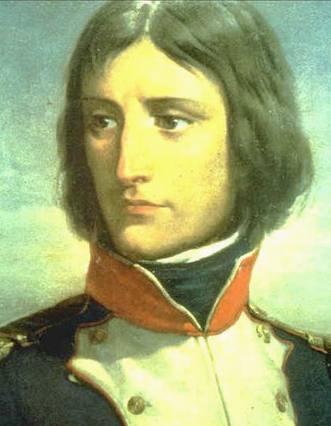
By 1798 the French government didn’t stand a chance. Not even the spirit of the French people could save the dictatorial Directory that was reversing all of the work that the French people had done to get equal rights. Could the French government have survived without Napoleon’s coup? In my opinion, it could not have. Napoleon’s intervention was necessary; a strong, cunning leader was needed to patch together of fractured France. Much of Napoleon’s government was about gaining power, manipulating deals, and getting the French people, and any other countries, to succumb to his will. Napoleon made peace with the Old Regime nobles, the church and the middle class. He set out the idea of a family unit where the father had complete power over his wife and children, much like Napoleon’s power over all of France. Could it be said that Napoleon’s creation of a patriarchal family unit be considered propaganda? Reflecting on the political environment, I believe Napoleon used this as a form of propaganda. As the southerners of the antebellum South in America in protecting their patriarchal power of both family and slaves promoted this concept of both paternal oversight and social stratification, so too did Napoleon wish to convey both an image of a protector and a ruler. This image is one that the French commoner would both understand and accept as the head of their government. It was Napoleon’s insight that finally led to unity in France, but Napoleon’s agenda went beyond the unification of France to the domination of a great empire.
It cannot be denied that Napoleon was a genius when it came to the strategies of the battlefield. Against most of Europe, Napoleon was able to amass a “Grand Empire”. By 1802, Napoleon had no need to battle others, he was popular with the French people, the government was stable, and all outside threats were gone; however, war was in Napoleon’s blood, so he fought. After a devastating loss to Lord Nelson in 1805 Napoleon defeated the third coalition, which was made up of Austria, Russia, Sweden and Britain. He began to organize a blockade, preventing British trade.
But war is costly. There is pay for the men, the purchase firearms and munitions, ships, food, lodging, training and countless other expenses necessary for success and Napoleon was successful. To afford these conquests, Napoleon began to tax the French heavily and draft copious numbers of men for his army. Napoleon’s attempt to blockade British trade backfired for Britain had decided to counter blockade. This kept the British from suffering from the French blockade while depriving the French middle class of their livelihood that was tied to trade. The cost of war and the deprivations linked to war dulled the golden light that had surrounded Napoleon and he was no longer a hero. He had become a tyrant.
Had Napoleon continued a successful march through Europe, conquering each subsequent country, his financial demands would have been met with a patriotic French populace but Napoleon committed military suicide in his attempt to overcome Moscow. Now crazed in his effort to gain power, Napoleon marched through Russia to the city of Moscow. But Moscow could not be defeated and Napoleon retreated, bringing home only half of the 600,000 men from his original army. Unclouded by his military ambition, Napoleon could have settled on a proposal to restore France to its former size. Instead Napoleon returned to France, raised a new army and set out to recover and then add to the land he had amassed, in earlier conquests.
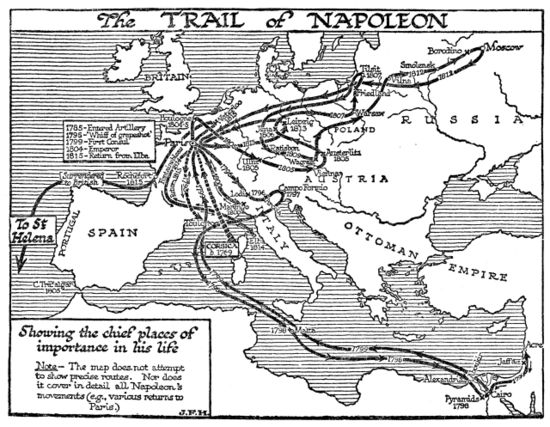
Even after being exiled to the island of Elba, Napoleon attempted to stage a comeback. But such an attitude, originally viewed as heroic must be question. Napoleon provided direction and strength when the country needed a leader. But when does it go to far? It was said that if Napoleon had just accepted France at it’s historical size that he would have been saved, but his own persistence turned around and slapped him. However, was it possible for a man with less of a vision and thirst for power to restore tumultuous France, I’m not so sure. Like many other great historical figures, Napoleon was a blend of genius and crazy, and his forceful ways did help restore France after the bloodiest revolution in history.

Thursday, November 11, 2010
Is Violence Really Necessary?

 In his "The Terror Justified" speech to the National Convention on February 5, 1794, Maximilien Robespierre describes the goals of the Revolution. "It is time to mark clearly the aim of the Revolution and the end toward which we wish to move;" To sum up Robespierre's justification of the Great Terror, he reasoned that only through violence can a people achieve equality. His words echo those of other great revolutionaries. The legendary Che Guevara once said "I am not a liberator. Liberators do not exist. The people liberate themselves." Both Robespierre and Guevara believed in revolution as the birth to equality and as the antithesis to oppression. The question is; is violence justified in the pursuit of liberty (happiness)? Is it necessary? Certainly, the sans-culottes depicted in Delacroix's "Liberty Leading the People" fearlessly pursue Liberty clad with swords and muskets as the American colonists pursued her against the British. Rather than taking a stance personally on this question, I'd like to see what others think first. If you don't believe that violence is necessary to achieve equality, can you provide a historical event that supports you? Or would you agree with Robespierre? and feel that he is vindicated in sending tens of thousands to their deaths. Che Guevara once said that a revolutionary is guided by love. But does love automatically guide us into violence?
Saturday, November 6, 2010
The Second Revolution & The Emergence of Political Groups
The Second Revolution was a period of the greater French Revolution that marked the government's rapid radicalization following the fall of the monarchy under Louis XVI. During this period, two political groups arose within the National Convention, the "Girondists" and "The Mountain", both seeking to control the republic. There is a distinct parallel in the emergence of political groups in both the French and the American Revolution. In both revolutions, each political group shared the similar foundational beliefs of government, yet had contrasting ideas as to carrying out these beliefs. Based on these two revolutions, political groups are a key feature of any changing nation's government. So on what basis did these political groups originate in France? Who were the "Girondists" and "The Mountain" and just what drove them to opposition?
With the imprisonment of Louis XVI, France found itself in utter ferment and bedlam.  During the September Massacres, hordes of angry crowds invaded Paris' prisons, killing nearly half of the people they found, under the suspicion that imprisoned counter-revolutionaries were plotting with invaders. In response to the chaos of the city, the popularly elected National Convention proclaimed the nation a republic in September 1792. As a whole, the republic wished to create a different popular culture that advocated its new order. Among the elements that it supported were: a new calendar system, and democratic festivals where the enthusiasm of the masses was directed to secular holidays that were meant to arouse the love of the nation.
While the governmental members of the new republic agreed on these elements, there arose a clear divide within the National Convention.  Much like the divide during the American Revolution of Republicans and Federalists, the Convention was divided into two groups of Jacobin members, the Girondists and the Mountain. The Jacobin was one of the political clubs that had permeated the neighborhoods of Paris from the inception of the Revolution. In these clubs, members both men and women debated the most pressing issues of the day. The Girondists were named after the southwestern department of France that was home to its leaders. The Mountain was named so because of its members' position on the upper bench of the assembly hall, and was recognizable by their famous leaders such as Robespierre. The emergence of these separate groups came about as a result of a most important political decision. While the National Convention agreed in its fundamental decision to convict Louis XVI of treason, there was quite a rift as to its terms. The Girondists did not want the king to be executed, while the Mountain called for his death. The Mountain ultimately won this battle with a slim margin of victory, and Louis was executed with the guillotine on January 21, 1793.
Despite their disagreement on this issue, both groups sought to further the "war against tyranny"; however, their differences of opinion did not end with the execution of King Louis. In the spring of 1793 "sans-culottes", or the laboring poor began to rise up in a demand for their daily bread during ravaging food shortages in Paris. Initially both groups agreed to ignore their demands, but soon the Mountain leader Robespierre sympathized with their suffering. Joining forces, the "sans-culotte" and the Mountain persuaded the convention to arrest 31 Girondist deputies for treason on June 2. It was at this point of the Second Revolution that the Mountain had gained control of the nation's power.
The events of the Second Revolution are quite similar to the division of political groups that came about during the American Revolution. In that case, both groups had fought for their nation's independence and sought to make their nation better, but disagreed as to where the power should lie, the Republicans advocating a weaker national government, while the Federalists advocated a strong one, both parties disagreeing on countless other issues. For France, their groups' basic beliefs were the same in that the king was treasonous, but how they handled it led to the divergence of their opinions. Each group had its own idea as to how to run the government. 
Personally, I believe that when a nation's government is coming into its own, the division into political parties is unavoidable. Despite the warning of George Washington in America, the Continental Congress split into the very first of the nation's political parties, as did the National Convention of France. Furthermore, I don't believe that this is at all a bad thing. In class we discussed this in depth. I believe that the emergence of political groups helps to represent all of the ideas of a nation. The way that groups work to better the government and represent everyone's ideas is to strike balance in their decision, as the Americans were able to do when they wrote the Great Compromise. Instead, during the French Revolution each group was essentially unwilling to compromise, seeking only to assert their own control over the government, as the Mountain forced the Convention to arrest members with opposing beliefs.
Based on this analysis of the Second Revolution, answer one or more of the following questions: Do you agree that there are there parallels between the emergence of political parties during both the American and the French Revolutions?
Is the emergence of political groups inevitable in government?
Do you believe that the emergence of political groups ultimately hurt France during the Second Revolution?
Is there such thing as "balance" in government? If so, could France have potentially achieved it?

Image Sources
http://commons.wikimedia.org/wiki/File:SeptemberMassacres.jpg

Wednesday, November 3, 2010
French Revolution = American Revolution?


During the period of time between 1789-1791, there were many political and economic reforms made. Before this time, France's social system was in shambles, as it made the lowest class, the peasant and urban poor, pay the highest amount of taxes, giving them a scarce amount of money for necessities like food. Food prices were rising as well, which did not help the peasants, as they could barely make only a half of what the bread was sold for. The commoners, both men and women, were both frustrated
 with their lifestyle and their social status. They started to make multiple attacks on political figures and start many revolts. This was the beginning of a revolution. However, to keep the commoners at bay, the monarchy, under the king, had passed multiple laws that are very familiar to those which were passed after the American Revolution under the Constitution. An example is the "Declaration of the Rights of Man and of the Citizen." Just from the title, it can be said that it is similar to the Declaration of Independence. Not only that, but the philosophy of both documents were strikingly similar. The French version states, "Men are born and remain free and equal in rights," while the Declaration of Independence states "We hold these truths to be self-evident, that all men are created equal, that they are endowed by their Creator with certain unalienable rights, that among these are life, liberty, and the pursuit of happiness." Both these lines sound the same and convey the same message.
However, both documents had different opinions about them. The Declaration of Independence had much favor from the Colonies, the exception being the Loyalists. However, the French document, instead of bringing peace, brought more revolt and havoc. The king had passed this bill, and the poor women of France had rebelled against him almost immediately. It also didn't bring peace as the Declaration of Independence did. Why did it turn out the way it did in France? Are the French just naturally chaotic? Were the people of the Colonies just more government-fearing? Why were they different?
The Frech did not respond as positively as the Colonists did, for the French had other aspects of their lives that remained unchanged, that kept them angry. It kept them against the government. They still had to pay their taxes and the vast majority
 still had them at a fairly high level. The Colonies, on the other hand, solved their issues on the battleground. It ended after the Declaration of Independence because the Colonies did not have any other issues besides equality and equal representation. The French, on the other hand, had many more reasons for the continuation of protest. The prices of bread were still rising, and the women were getting frustrated. Also, Marie Antoinette was simply despised by the people of France.
What do the similarities mean? They were similar because most people during this time period were slowly reforming their idea of certain types of people being above the rest, and developing a sense of equality and things being fair and just. The Colonists reformed their idea of the British being on top, and made their new country all equal, with the exception of slaves, of course, but that was abolished soon after. The French were also reorganizing their social system and made the people equal in terms of rights and liberty, however the financial classes still remained. These similarities opened up the new age of civilizations and empires having equal treatment, and the word "equal" to be applied to such aspects as slavery and women's rights.
Thursday, October 28, 2010
Comparing the French and American Revolutions
Both the American Revolution and French Revolution were prompted in similar ways, though the French Revolution was more based on social inequities than the Americans’ desire for political independence. In 1748, a 5% income tax was appointed on every French civilian, regardless of social class. The tax was implemented in an attempt to pay off the huge debt from the War of the Austrian Succession. In fact, France would become even more indebted after helping the Americans with their revolution. Likewise, Britain first taxed the colonists with a similar goal: to pay off the expenses from the French and Indian War. The first tax to cause a major uproar amongst the American colonists was the Stamp act. In both of these situations, the taxes were protested against. French civilians claimed that the new taxes gave too much power to the king and violated their liberty. A significant difference though, is how France and Britain chose to respond to these complaints. While France caved in and dropped the taxes, we know that Britain stood adamant with the decisions, at first suppressing the colonists, but finally repealing the Stamp Act in 1766.
Despite the similarities stated above, it is equally important to touch on the obvious differences between these two historical events. The French and American revolutions were both based on Enlightenment values that emphasized the ideas of equality and natural rights, but the American revolution was fought to gain political freedom/equality, while, from what we have read, the French Revolution sought to achieve social equality between the three French estates. Another of the most fundamental differences between the two revolutions was their contexts. The American Revolution was fought against the tyrant Britain to gain complete independence from the tyrant Britain while the French Revolution was more of a civil war fought amongst the French people rather than another country.
Though the French Revolution was in theory inspired by the American Revolution, which could be considered the first democratic revolution in history, it did not closely parallel it. Though it may seem there are many connections between the two, as we read on, we will see that the two revolutions were in fact very different in motives and outcome. What do you guys think? Do you see the connections between the American and French Revolutions, and what are your predictions for how the French Revolution will play out?
Sunday, October 24, 2010
The Challenges Ahead for the New Nation after the Constitution
 |
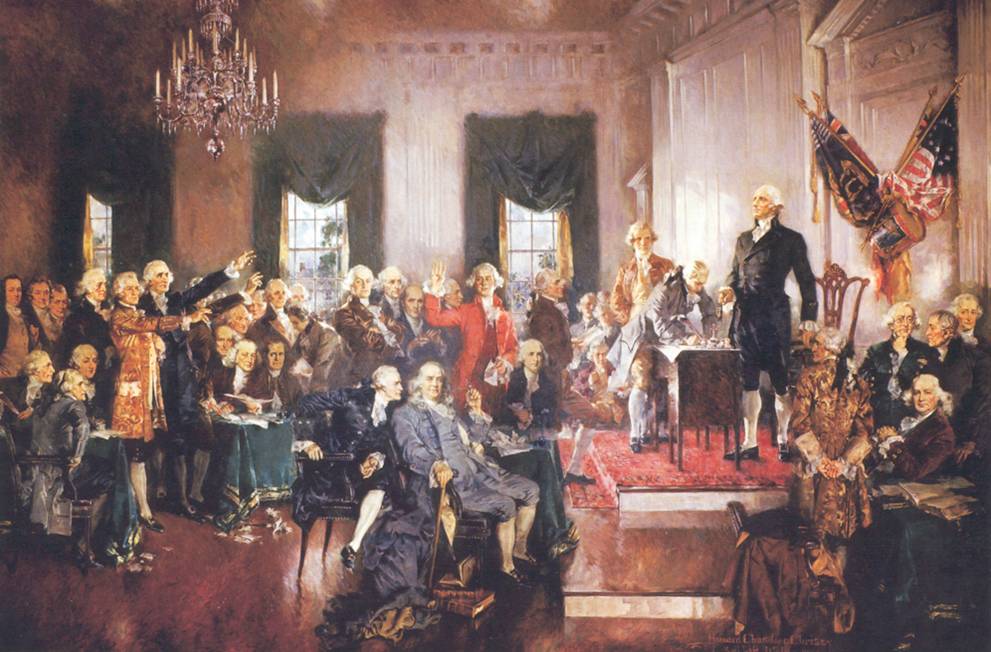
| The Signing of the Constitution |
 |
| Slavery in America |
 |
| America circa 1790s |
Wednesday, October 20, 2010
Hamilton: The Shaping of America
